
KK Fashion Exports is a garment manufacturer and exporter in Delhi NCR. We have made and exported clothing from the region since 2003. We make dresses, shirts, kaftans, pareos, scarves and bags for brands and wholesalers abroad, from our own unit in Noida.
Production runs from an integrated production facility at F-22, Sector 6,
Noida, Uttar Pradesh, with separate storage and warehousing space. The
registered office is at C-142, Lajpat Nagar 1, New Delhi 110024. Cutting, stitching, finishing,
packing and dispatch happen under one roof in Noida.
Garment manufacturers in Delhi NCR: why buyers source here
Delhi NCR is one of India’s main centres for garment manufacturing and export. Noida, Okhla and Gurugram together hold a large share of the country’s woven ladieswear, printed textiles and accessories. For a buyer, the region has several practical advantages:
- Fabric and trims nearby. Fabric markets, printers, dyers, embroiderers and trim suppliers are close, so samples and corrections move in days.
- Export routes. Sea freight clears through the Tughlakabad and Loni inland container depots and moves by rail to the western ports. Urgent samples and air shipments leave from Delhi airport.
- Easy visits. Our Noida unit is a short drive from New Delhi, so you can see the production line, the fabric and your sample in a single day.
As a garment exporter in Delhi NCR, we handle the export paperwork, inspection and shipping on FOB, CIF or DDP terms. Our minimums are low: from 100 pieces per style, per colour for scarves and bandanas, and from 200 for dresses and kaftans. Details are on the minimum order quantity page. To arrange a visit or a quote, use our enquiry form.
Production facility
The facility handles in-house stitching, screen printing, ironing and finishing, backed by
separate storage and warehousing space. Packing and inspection are handled by an in-house team.
Equipment
- In-house pattern making
- Garment cutting machines
- In-house stitching machines
- In-house screen printing tables, able to print on all our fabric qualities
- Rolling ironing machine and steam ironing tables
- Garment thread vacuum trimming machines
- Washing and drying unit, with dry-clean chemicals
- Needle detector machine
Printing and dyeing capacity is held through a dedicated unit in Uttar Pradesh operated by our
partners, established in 2018. Additional stitching capacity is contracted from partner units when a
programme exceeds our in-house line. We say this plainly because it is the question a buyer should
ask, and because an honest answer is easier to verify on a factory visit than a claim of total
self-sufficiency.
What we actually produce most of
Installed capacity tells you what a factory could do. Product mix tells you what it does every
week, which is usually the more useful number. Our core products, roughly in order of how often we make them:
- Dresses
- Shirts
- Kaftans
- Pareos and sarongs
- Scarves
- Tops and tunics
- Skirts and trousers
- Bags, kimonos, shorts and shawls
By piece volume the order changes: scarves and pareos are the highest-volume categories because
they run in larger lots, while dresses and shirts generate the most individual styles. If your
programme is woven ladieswear or a printed accessory, it sits in the middle of what we do every day.
If it is knitwear, tailoring or outerwear, it does not, and we will tell you.


Process under one roof
- Fabric procurement and inward inspection
- Pattern making and grading
- Cutting
- Printing — screen in-house, digital and dyeing through the partner unit
- Stitching
- Washing, drying and pressing
- Finishing, thread trimming and needle detection
- Inspection and packing
- Dispatch and export documentation
Every order passes eight documented inspection points.
What happens between stitching and packing?
A garment is not finished when it leaves the sewing machine. These steps decide how it looks and feels when it reaches your store, and they run inside our Noida unit.
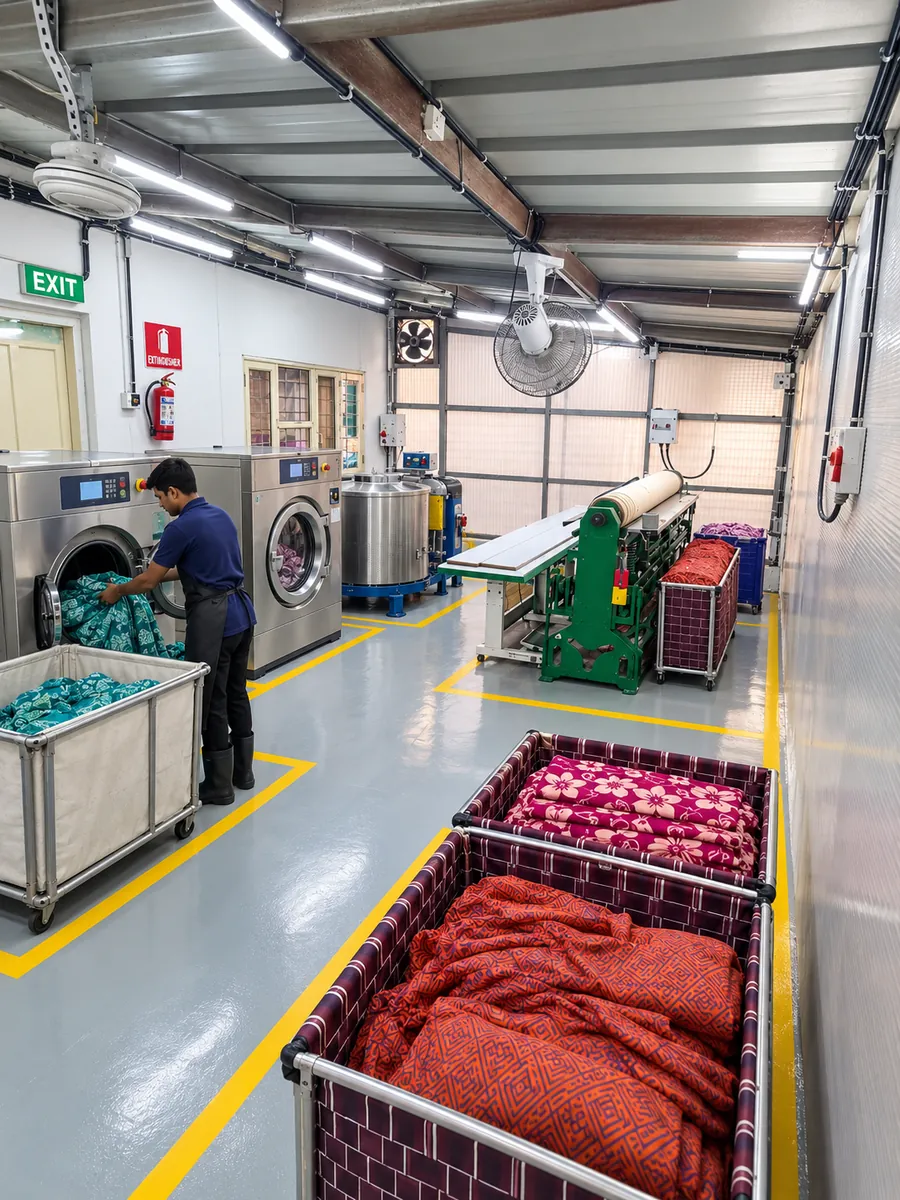
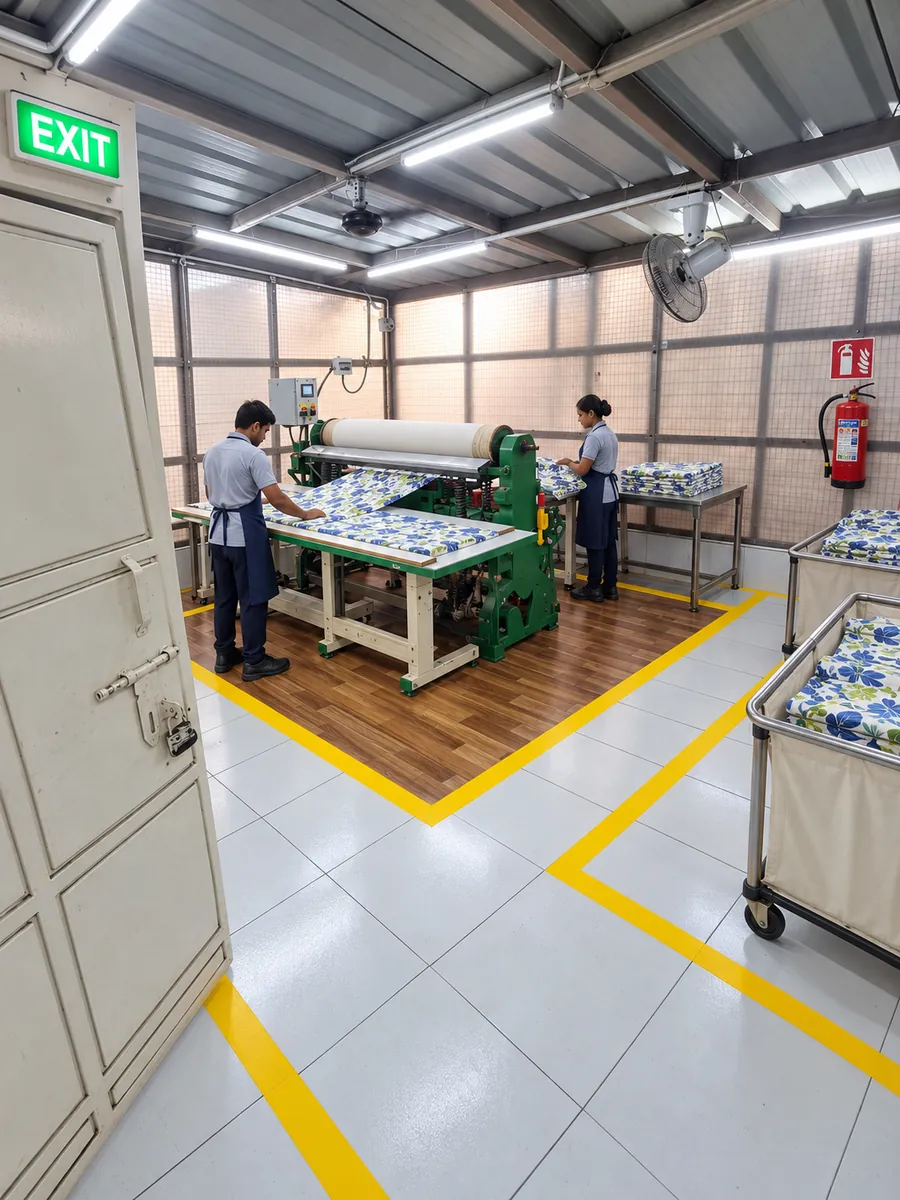
- Washing. Fabric and garments are washed in-house when the order needs it, for example to soften the hand or pre-shrink.
- Calendering. Printed fabric is calendered in-house, so it lies flat and smooth before it goes to the cutting table.
- Vacuum ironing. Every piece is pressed on a vacuum ironing line, then given a final press before the last check.
- Fabric store and carton packing. Fabric is kept on shelves in a separate fabric store. Finished goods are folded and packed in export cartons at packing tables, to the buyer’s packing standard.
What are the eight quality checkpoints?
- Raw fabric inspection
- Printed fabric sample inspection
- Bulk printed fabric inspection
- Bill of materials inspection
- Stitched sample inspection
- Mid-line stitching inspection
- Pre-packing inspection
- Inspection while packing
Composition, colour fastness and lead- and nickel-free trims are checked for each order, and every finished piece passes the needle detector.
Can I see samples and talk to one person about my order?
Yes. Our showroom in Noida holds ready designs across scarves, resort wear, garments and accessories. You can walk the racks, pick styles, and we adapt the colourways, fabrics and sizes for you. Sampling is done in-house, and we can also develop from our own print library or from your artwork.
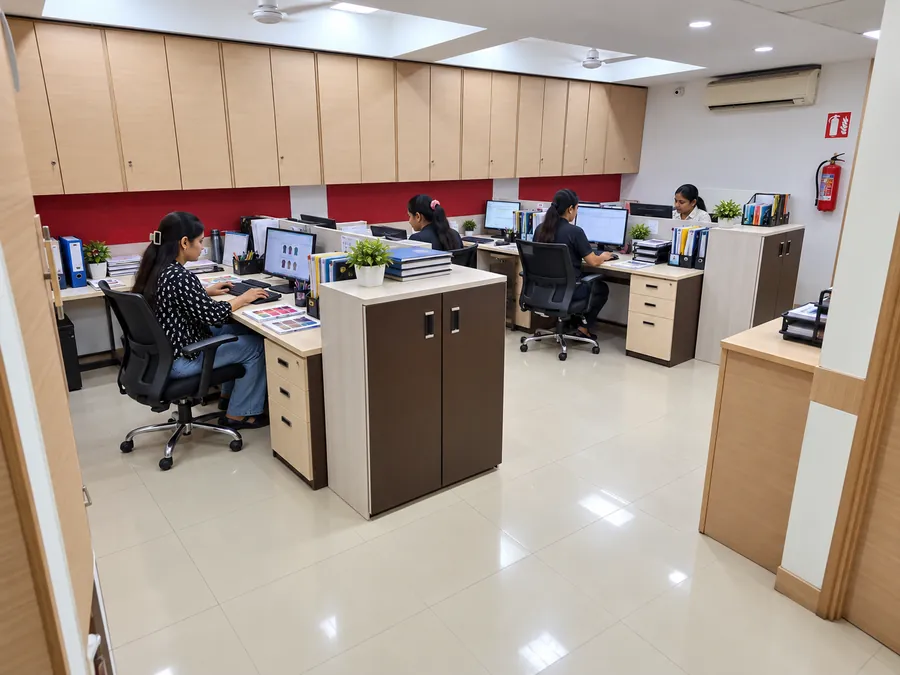
Each order has a dedicated merchandiser who follows it from enquiry to dispatch: costing, sampling, lab tests, production tracking, inspection booking and export documentation. We respect every contract and NDA.
How the facility grew
| 1995 | Founder Sanjay Kumar Sadh begins garment manufacturing and export |
|---|---|
| 2003 | K K Fashion Exports established |
| 2014 | Moved to a larger carpet-area factory |
| 2018 | Printing and dyeing unit added in Uttar Pradesh, partner operated |
| 2021 | In-house stitching and fabrication unit added |
| 2025 | Consolidated into the current integrated facility |
Compliance
Our production is independently audited for ethical and social compliance. Statutory registrations are on the
certifications and compliance
page.
Factory visits are welcome, announced or unannounced, and we would rather you came than took this
page on trust.
Equipment
described above reflects our own installed capability and is not third-party audited — ask to see
it on a visit.
